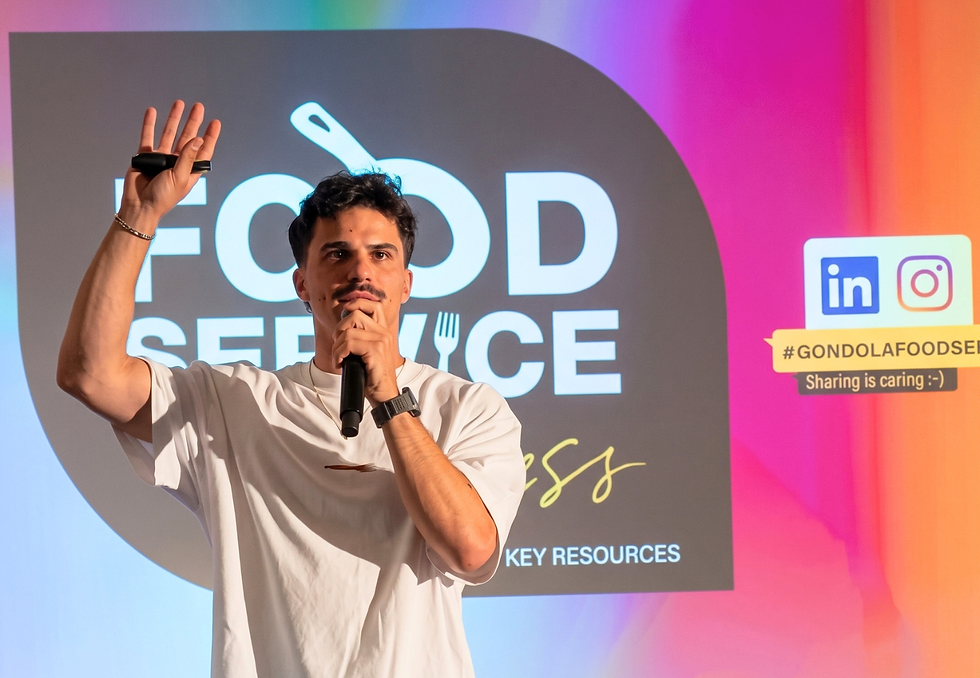
At Flora Food, they work backwards: The "fork to farm" approach

At Davos, Flora Food Group's Chief Corporate Affairs Officer challenged the "farm to fork" mantra that has become well-entrenched in food system discussions. For Herman Betten, the approach needs to be flipped, starting with what consumers actually need. Far from a theoretical concept, this is exactly how the world leader in plant-based butter alternatives develops culinary essentials in over 100 countries.

"We talk a lot about 'farm to fork', but not enough about 'fork to farm'," said Herman Betten, Chief Corporate Affairs Officer at Flora Food, during the recent Open Forum at Davos. The phrase neatly sums up his conviction: food systems transform through usage. "Food can only have an impact if it is actually consumed."
Founded over 150 years ago to address malnutrition issues in Europe, the specialist in plant-based alternatives to animal fats advocates a decidedly pragmatic approach: start with the consumer, not the field. Then, work your way back up the value chain.
This logic is grounded in the reality of the kitchen. "Our products -spreads, creams, liquids-are not made to be consumed in isolation. No one goes home to eat a tub of margarine in front of Netflix. Well, you could, but I wouldn't recommend it," he explained with a touch of humor. Flora Food produces everyday ingredients, intended to be prepared by real families and integrated into real meals.
Taste First
For Betten, any ambition to transform the food system fails if it ignores a fundamental principle: "If it doesn't taste good, people won't buy it." That is why at Flora Food, they work "backwards, starting from the kitchen table. Our products are found in more than 100 countries, in real kitchens, used by real people making real meals."
The company behind popular brands such as Becel, Fruit d'Or, and Planta Fin (to name just three) collaborates with chefs and food professionals to understand what truly works. "What is effective in a busy kitchen, what families can afford, and what tastes familiar enough to become a habit," he insisted.
Next come price, nutritional value, naturalness, and only then, sustainability. "Sustainability is essential, but it is not the first criterion for which consumers are willing to pay more," he acknowledged. This is an embraced realism, based on a constraint often forgotten in international forums: purchasing power. "A European family of four has an average of 80 to 100 euros per week to spend on food. That’s not a lot."
From African Fields to European Tables
"It’s not just about producing sustainably, but enabling farmers to invest in their future," highlighted Herman Betten. Flora Food Group works specifically with canola farmers in East Africa. The objective is twofold: ensuring fair prices and strengthening farm resilience. "Call it regenerative agriculture if you want; the important thing is that crops remain available, affordable, and provide a decent income for farmers."
Educating Without Moralizing
On the issue of nutrition, the group relies on indirect education. "We all grew up with the idea that fats were bad," recalled Betten, who also serves as Communications Director for the Dutch leader. "Some are, like trans fats, for example, but others are essential."
Through an extensive network of nutritionists, the company defends the role of unsaturated fatty acids, particularly omega-3s. "A child who doesn't suffer from an omega-3 deficiency can gain up to three or four IQ points. That can make the difference between reaching their full potential or not."
At Davos, calls for collective action were plentiful. But Herman Betten warned against false solutions. "A partnership only works if it solves for consumer acceptance, farmer livelihoods, and planetary boundaries all at once," he declared. "If you miss a single one, you are piloting a project, not scaling up." A useful reminder on the sidelines of a World Economic Forum often accused of prioritizing grand visions over daily realities.