From "construction chaos" to the 2026 Michelin Guide: Chef Bianchin's strategic recipe

Streamlining staff and inventory, a new location, expanding the catering service… In just a few months, chef Alain Bianchin has managed to leave his restaurant in Overijse, which held a respectable Michelin star but was struggling financially, to reinvent La Table in Ohain. And to establish the restaurant as the only one in Wallonia to receive a first-ever Michelin star in the latest guide.
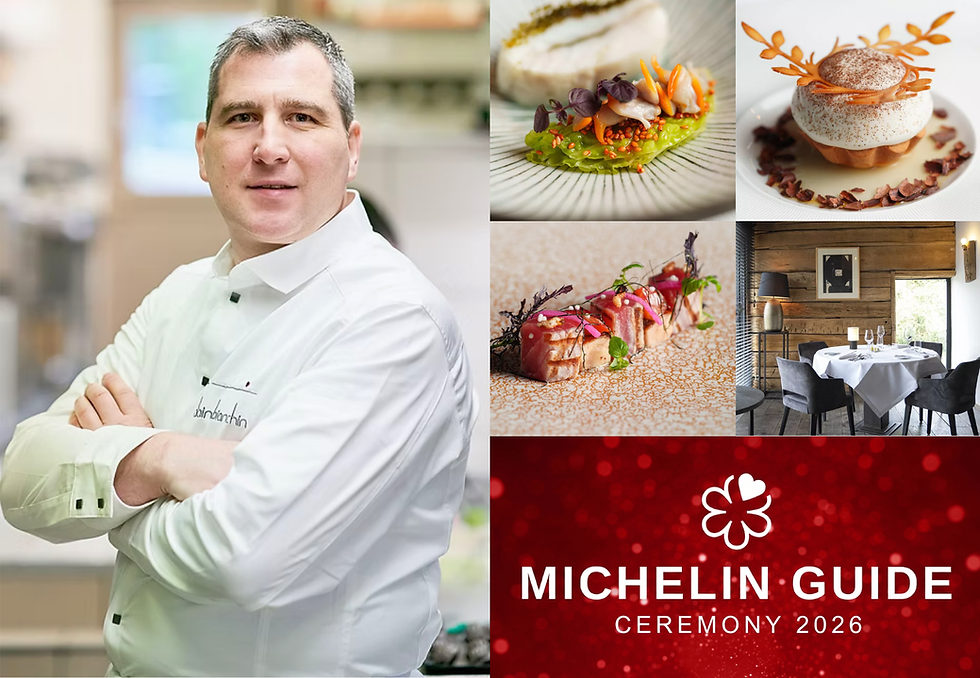
“Alain Bianchin is a true craftsman, with meticulous technique. The kitchen is his playground. His sublime menu showcases exceptional products. The lovely view of the green hills of Lasne admirably completes the picture in this contemporary restaurant.” These heartfelt words come from the 2026 edition of the Michelin Guide, whose inspectors this Monday recognized the exquisite work orchestrated at La Table-Lasne by the Belgian chef.
We'll set aside culinary poetry here to highlight another of Alain Bianchin's masterstrokes. Not the harmonious pairing of his tuna and foie gras with blood orange, but his strategic move from Jezus-Eik (Overijse) to Ohain (Lasne). Because last November, faced with the unjust collapse in customer numbers and a turnover cut in half, the owner of La Maison Alain Bianchin had closed the doors of the restaurant that had held a Michelin star since its opening in 2015.
After three financial years marked by losses, and with 2025 results also showing deficits, the alternatives were few and far between: the choice was between dissolving the company and implementing restructuring measures. "The situation after the Covid period evolved favorably, but since the beginning of 2022, the company's profitability has declined," the manager explained in his latest management report, citing first and foremost the major role of "inflation and economic uncertainty, forcing Michelin-starred restaurants to cope with a drop in their customer traffic."
From 2023 onwards, accessing the restaurant became a real ordeal due to public works initiated at the Léonard intersection and its tunnel near the establishment. Adding insult to injury for the Michelin-starred chef, in 2025 the redevelopment project for the center of the village of Jezus-Eik, where La Maison was located, caused "even greater disruption," according to Alain Bianchain. "The chaos generated by the construction, the lack of parking spaces, and the general state of the immediate surroundings (litter, noise, vermin) are leading to a drop in reservations and significant difficulty in recruiting and retaining staff."
A strategic action plan
Alain Bianchin believes he analyzed all the possibilities and made the necessary "well-considered decision" regarding his Horeca business. But the Michelin-starred chef first focused on developing a recovery plan. He undertook a series of actions to try to get back on track and reinvent his business model. Minimum wage
As managing director, he paid himself a minimal salary. Reducing fixed management costs is an emergency measure aimed at preserving some of the cash flow of a restaurant whose profit margin hovers around 2%. This measure also demonstrates a strong personal commitment to financial and commercial partners, with the manager prioritizing the survival of the business over his own income.
Equity contribution from shareholders
The injection of funds into the current account allowed for a rapid replenishment of cash reserves without resorting to heavy and burdensome bank debt. This strengthens the company's financial structure, reassuring creditors about the institution's solvency.
Marketing actions
Alain Bianchin leveraged marketing and social media. His investment in digital channels targeted the acquisition of new customer segments while modernizing the Michelin-starred chef's brand image. This direct communication strategy can help maintain bookings and even foster a loyal and active community around the chef.
Staff reductions
Streamlining payroll allows operating costs to be aligned with actual activity levels, thereby limiting the operating deficit. It's a drastic but necessary measure to restore profitability in a sector where personnel costs are the largest expense.
Reduction in wine stocks and purchases
By limiting purchases of fine wines and the amount of wine stored in reserves, the chef frees up working capital that was unnecessarily tied up in the cellar. This just-in-time management optimizes cash flow and minimizes the risk of financial losses related to inventory.
Limited choice of dishes and price adjustments
Simplifying the menu reduces complexity in the kitchen and food waste, while optimizing profit margins per cover. Adjusting prices makes the offering more accessible, thereby increasing occupancy rates and ensuring consistent revenue.
Expansion of the "catering" service
Developing a catering service allows for the diversification of revenue streams by utilizing production facilities outside of traditional service hours. This maximizes the profitability of assets and labor, while extending the chef's reputation beyond the restaurant walls.
Looking for a new location
Chef Bianchin didn't decide to change restaurants on a whim. His strategic approach aimed to break away from an increasingly unfavorable economic environment. The move allowed him to restart on a healthier structural foundation, often better suited to the restaurant's new positioning.
A new address in a neighboring village. A completely different economic environment
Just sixteen kilometers separate the old restaurant, located on the Chaussée de Bruxelles in Overijse, from the new one, established on the Rue du Try Bara in Lasne. But the geographical repositioning and socio-economic targeting don't seem accidental. By setting up shop in the wealthiest municipality in Wallonia, Alain Bianchin is moving from an area where he was literally blocked to an ecosystem where consumer habits and purchasing power seem perfectly aligned with a Michelin-starred gastronomic offering.
This shift lowers a certain psychological barrier related to price. Local customers are more inclined to order full menus and quality wines, thus securing revenue per person. The chef has, in fact, implemented a significant price increase: 18% for the lunch menu and 24% for the four-course menu. That said, the fact that the prices are still perceived as "reasonable" by critics demonstrates that the value proposition remains strong.
This increase helps to more easily cover fixed costs and improve the gross margin. Especially if customer traffic remains at the level La Table-Lasne experienced shortly after its opening: an average of 60 to 70 covers per day. A remarkable achievement for a restaurant of this caliber. This volume suggests efficient table turnover, particularly thanks to the weekday lunch menu, which can attract a business clientele.
Offering a variety of options, from a quick lunch to a six-course tasting menu, allows for a segmented customer base. By providing menus tailored to different time constraints and preferences, the establishment aims to maximize occupancy rates. This versatility prevents it from being confined to a purely elitist offering, while also showcasing higher-value options (extended menus with wine pairings) to optimize the average spend.
Crucially, the team at La Maison followed the chef to La Table, including Gilles Hequet, his second-in-command for the past seven years, who is a key figure in the operational strategy. In an industry characterized by high turnover, this loyalty is a competitive advantage. The two share a common set of standards and sensibilities. This stability guarantees consistent quality, a crucial criterion for Michelin inspectors, and reduces training costs. Not to mention that it allows the chef to focus on overall management and strategic development.
The model of the passionate craftsman will remain fragile if it does not incorporate a chef-entrepreneur dimension, where culinary excellence is supported by a robust financial structure.