Eline Biesmans (La Patate): "We want to reclaim city centers from the big international chains"

INTERVIEW – With traffic flow meticulously planned down to the millimeter, no paper order forms or refrigerated displays, nothing will be left to chance in La Patate's first location. The CEO reveals the engineering designed to guarantee the best chip shop experience.

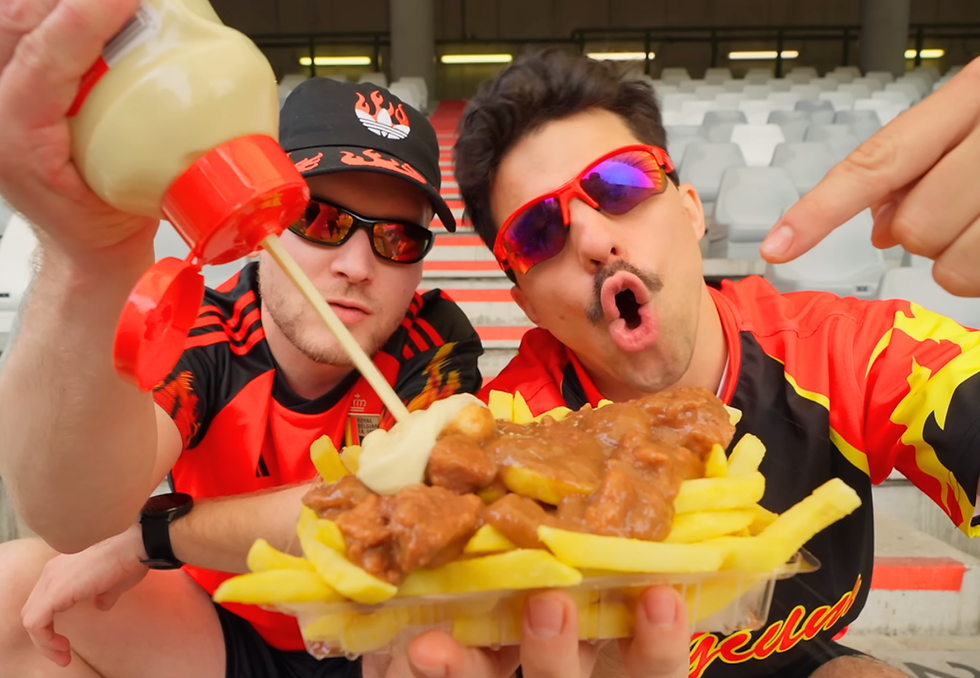
“O n met la patate”. Belgium’s unofficial anthem takes on a whole new dimension this Friday, May 8th: web sensation Average Rob is opening his own “frietkots” (fry shops) near Antwerp Central Station. The media have extensively covered this initiative, which aims to promote a relic of Belgian culture, and have thus highlighted the friendly “Ghent mafia” behind the project: serial entrepreneurs Jorn Vanysacker and Gilles Mattelin, co-founders of Tout Bien beer; Jean-Michel Teerlinck and Julien Malingreau, who oversee about ten restaurants and cafes in Ghent under the MTM umbrella; as well as Jan Froyman and Wim Vernaeve, contributors to the success of Hawaiian Poke Bowl, among others, through their Ghent-based investment fund, Green Park.
While the spotlight has been on this all-male millennial collective, the actual leadership of this emerging chain rests on the shoulders of a woman in her thirties, also from Ghent: Eline Biesmans. She is the CEO of La Patate . She is the one responsible for transforming the buzz into operational reality. Eline cut her teeth in the foodservice division of the Colruyt Group. There, she learned to operate in a complex environment, to lead large teams, and to manage ambitious projects. "It's like going from a huge oil tanker to a speedboat," she smiles, "and to be honest, I've been missing that for a while." Interview.
Gondola Foodservice: Eline, how does one go from Solucious to La Patate?
Eline Biesmans: Solucious was an excellent training ground, but at that scale, it's simply difficult to change things quickly. At La Patate, I'm the captain. Decision-making lines are short, the environment is agile, and I have the freedom to actually build something. What I take from my years in the corporate world, like structure, process-oriented thinking, and scalability, is combined here with the energy and impact of a small team of entrepreneurs. For me, it's the ideal combination, the best of both worlds in something you build yourself.
La Patate aims for a rate of 100 orders per hour, while promising a "no-batching" approach to guarantee freshness. It's a huge challenge. How do you plan to achieve this? An army of servers, automated kitchens?
One hundred orders per hour is an ambition, not a starting point. We're not there yet today, but it's a perfectly realistic benchmark for major fast-food concepts.
The foundation lies in the very design of the kitchen. We worked very closely with the kitchen designers to plan the traffic flow. In fact, we operate without a display case for the snacks, which allows for a different and more efficient kitchen workflow.
Furthermore, we rely heavily on our Kitchen Display Systems (KDS), which we developed from scratch with KitchenConnect. This allows us to work station by station, without physical order slips. The system is designed so that even students or flexible staff with no prior experience in the food service industry can become operational quickly.
A chip shop is a very complex environment: lots of ingredients, highly personalized orders, and a large margin for error. If you receive curry ketchup when you ordered regular ketchup, it's an easy mistake to make, but for the customer, their "special fricadelle" is ruined. That's precisely why we invest heavily in training and systems that reduce this complexity.

You're focusing on homemade recipes for classic dishes (Flemish carbonnade, vol-au-vent). With a target of 20 outlets in 4 years, are you planning a central kitchen to guarantee consistent taste and food safety, or will each unit retain its production autonomy?
We developed our Belgian classics, carbonnade sauce, carbonnades, vol-au-vent and meatballs in tomato sauce, with our partner through a very thorough process including 6 cycles of taste tests and more than 150 testers.
We deliberately opt for centralized production. This is as much a matter of food safety as it is of quality assurance: we want to offer exactly the same taste experience in every establishment. However, we remain attentive to regional preferences. For example, in Limburg, carbonnade is eaten sweeter.
This centralized approach also opens the door to the retail sector. Once we are operational and quality is guaranteed, bringing our classic products to supermarket shelves will be the next logical step. We want to promote Belgian products not only in our stores, but also at home.
French fries are one of the products that don't travel well during delivery. How does La Patate plan to offer the "best fries delivered" in Belgium? Revolutionary packaging, a magical potato variety, an innovative cooking method?
The honest answer: delivering fries remains a challenge. You can't solve it with a magic potato variety; to my knowledge, it doesn't exist (yet?). We simply use a Belgian Fontane potato. The solution lies in a combination of several factors.
First, no-batching. We deliver using a model where the fries go directly from our warehouse to the customer, without combining multiple orders. Second, we only deliver within a 12-minute radius. The fries must be at the customer's door within that time.
Furthermore, we're working on integrating delivery into our KDS systems so that the driver is already waiting when the order is ready. This eliminates unnecessary waiting times. If a fry has to wait 3 minutes, it's a disaster. We're also exploring packaging solutions that better wick away moisture to keep us "the hottest fry in town."
Your strategy relies on prime city-center locations, where rents are highest. Historically, chip shops have left these areas in favor of large QSR chains.
We find it a great shame that our traditional Belgian chip shop is disappearing from city centers, driven out by large international chains. We want to literally reclaim that space. The chip shop belongs in the heart of the city, preferably on the Grand-Place, not on the outskirts.
AAA locations do indeed have the highest rents, but proportionally to the spontaneous traffic and brand awareness you create, these locations are certainly worth it.
We deliberately play on this aspect. The "shack" is literally at the front; we always open the facade completely with large windows so that customers can enter without any barrier. It should feel like going directly from the street inside. "If you can smell it, we're open."
“We are a Belgian brand with international ambitions. We see Belgium more as a test case where we are developing our processes.”

What is your main lever for generating sufficient margin: pure volume, or a product mix with high margins on drinks, such as a very cold "All Good"?
Our profit margin doesn't come from a single lever, but from a combination. On the one hand, we maximize all sales channels: in-store, kiosks, patio, click & collect, our own ordering website, and several delivery platforms. On the other hand, we strongly drive operational efficiency through a kitchen layout that allows us to work with students and flexible staff.
We also consciously choose a volume-oriented model with an affordable price. No small fries for 10 euros. And the "build your own loaded fries" concept plays a concrete role in increasing the average order size through customization. With us, you can create your own "julienke." A fry with carbonnade sauce, mozzarella fingers, fresh tartar sauce, and our own BBQ crunchy toppings, ketchup, spices, or cheese: treat yourself.
You have assembled a solid shareholder base, but there's talk of raising €500,000 through crowdlending. Do you primarily want to transform the Average Rob community into "shareholder-ambassadors" and, ideally, into repeat customers?
It's primarily a financing tool that has gained popularity in recent years and allows us to accelerate our growth in an accessible way. At the same time, it's a great opportunity to more closely involve a community with the brand. Those who invest automatically become stronger brand ambassadors and repeat customers. We also offer cool but tangible benefits as an additional way of recognizing their commitment.
We will deliberately cap the investment so that as many people as possible have the opportunity to participate. For us, this is part of a larger story of building a community around a Belgian brand with international ambitions. We also find it simply wonderful that Belgians can co-invest in their own Belgian chip shop, which we also intend to expand internationally quite quickly. We see Belgium more as a "test case" where we are refining our processes.
The launch benefits from Average Rob's brand recognition. However, restaurant history shows that initial curiosity quickly fades. How do you plan to transition from a "place people go for the Rob brand" to a destination they return to for quality and experience?
It's a huge blessing to have such an ambassador for La Patate and Belgian chip shop culture. Rob lives and breathes this culture in everything he does, but that's not what should sustain the model in the long term.
What sets us apart is that fries aren't a fad; they're a true staple. Belgians have a deeply ingrained fries ritual associated with a specific day. And it's precisely in urban centers that we've noticed the limited availability of them, largely due to permit restrictions. This creates an opportunity for a strong and accessible fry shop experience.
Our concept is also built on much more than just the brand. We're bringing back the "chip shop" as a recognizable place, with a solid offering of Belgian classics, customization through loaded fries, and an experience that makes people want to come back spontaneously. The ambition is for the brand to open the door, but for the quality of the products, a sharp price point, and a unique experience to ensure that people remain loyal.

You advocate for traditional preparation in beef fat. This is a strong choice for authenticity, but a polarizing one given the rise of vegetarianism. Have you planned an operational alternative, such as a specific fryer, so as not to alienate a growing market segment in urban areas?
We made a very conscious choice in favor of authenticity and the taste experience. The typical Belgian fry experience involves cooking them in animal fat; this is what gives them the most recognizable and richest flavor profile – yes, we've tested that extensively too (laughs). We work with a blend of beef fat and vegetable oils, so the fries aren't too heavy either. In some locations with enough space, we're not ruling out this option in the future, but for now, we're fully committed to the authentic taste experience.
We know that the "Tout Bien" beer is in a growth phase, but remains financially fragile. To what extent does La Patate serve as a strategic extension or an exclusive showcase to stabilize the brewery's sales volume and create a vertically integrated ecosystem?
Both brands have their own growth trajectory and their own investor base. Tout Bien has already built a much larger distribution network and a solid growth history. They want to sell a pilsner to every Belgian and are doing very well in that regard. A limited number of La Patate chip shops isn't going to dictate their success.
What is true is that there can be strong synergy within the overall ecosystem. We will collaborate on experiences, activations, and events, where the brand and the community intersect. But operationally, these remain two distinct business models. The strength lies precisely in the fact that each brand is self-sustaining, and that we mutually reinforce each other's visibility where it's relevant, without any dependence in terms of revenue or volume.
Going from 1 to 20 establishments requires a strong company culture, especially in a hospitality sector facing a labor shortage. How do you plan to instill a "let's give it our all" mentality in your teams on the ground, so that the service is as fast and "cool" as the project itself?
The hospitality sector does indeed have a labor shortage, but we're experiencing it differently at the moment. There are many people with a genuine passion for chip shops, but the problem is that starting your own chip shop is a capital-intensive investment with a lengthy administrative process, which is impractical for most. So we're finding many enthusiastic people who already possess this commitment and love for the product. This culture is deeply ingrained in us Belgians; we don't have to create it.
Our job is to give this passion a home. We do this by building close-knit teams around our establishments, with permanent staff who are given real responsibilities and feel a sense of ownership. Antwerp will be our blueprint, our starting point. From there, we will develop new establishments so that the culture and working methods are organically passed down from person to person.
What makes this possible is that we integrated scalability into the model from day one. What works in the first location – the processes, the team structure, the way of working – must also work in the twentieth. We built this consciously, notably through a scalability study conducted with an MBA student from Vlerick.
At the same time, we intentionally remain close to operations. The team works literally above the facilities, not in a distant headquarters, so that we can listen to our teams daily and make rapid improvements.
You mention exporting the concept as soon as the Belgian network is consolidated. In your opinion, what is the most difficult element to export at La Patate: the supply of fresh Belgian potatoes or the transmission of the specific "chip shop culture" to foreign franchisees?
Both are real challenges, but supply is certainly manageable operationally: Europe is not so big that supply from Belgium cannot be guaranteed.
The real challenge lies in our chip shop culture. We'd like to be as well-known as Japanese sushi, German bratwurst, or Mexican guacamole. A chip shop is a Belgian ritual. Translating that feeling into another context, without reducing it to a generic fast-food concept, that's the real challenge of exporting. And teaching the Spanish how to eat vol-au-vent, perhaps, too. (laughs)